

Change the tempo of your sheet music.
Slow down your sheet music without changing its key, and practise at a pace that suits you.
Choose a score to slow down
PDF, photo or MusicXML
Printed music · up to 20 pages / 25 MB
Sign in to open your own score.
Try it with Respighi.
The Pines of Villa Borghese
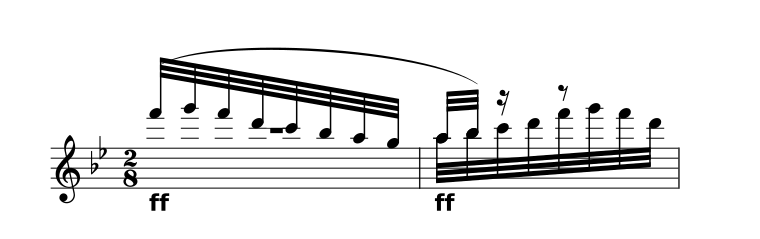
2/8 · two eighth-note beats
Quarter note = 72 · 78% of the original opening tempo.
About the prepared demo
The complete movement pairs the original 1925 Ricordi score with a CC0 community transcription. It opens prepared reference notation, without running a scan.
All 43 source parts and 51 staves are retained. Timing repairs, instrument sounds and interpretation limits are documented.
View the original PDF Sources & preparationHow to change the tempo
Open your score
Choose a PDF, photo or MusicXML file. Check the notes and rhythms.
Set your practice tempo
Choose a quarter-note BPM value. The pitch stays the same.
Practise the passage
Loop the bars you need and raise the tempo when you’re ready.
Give yourself more time between the notes.
Set an exact starting tempo in quarter-note beats per minute. Pitch stays the same, so you can practise slowly in the original key.
- Read the beat unit
- This example uses quarter-note BPM. In 6/8, quarter note = 96 is the same speed as dotted quarter = 64. The meter stays 6/8.
- Keep changes in proportion
- Changing the starting tempo scales the supported tempo map. The example’s local changes come from editorial reference data, not printed ritardando recognition.
- Keep your pitch
- A slower practice tempo gives each note more time without changing key. The source PDF and its printed markings remain unchanged.
A few useful answers.
What does BPM mean?
BPM means beats per minute, with a named beat unit. This preview uses quarter-note beats. In this 6/8 example, 96 quarter-note BPM equals 64 dotted-quarter BPM; those numbers describe the same speed.
Will slowing down change the pitch?
No. Tempo changes the timing of the notes. Use Key separately when you want to transpose the score.
Does Inklef follow every written tempo instruction?
Playback uses supported tempo data in the score. Recognition and expressive instructions still need review, especially in orchestral music. Check score notes for unsupported markings; the BPM control is not proof that every ritardando or accelerando was interpreted.
What can I upload?
PDF, JPG, PNG or WebP of printed music, up to 20 pages and 25 MB, or MusicXML/MXL. Sign in to open your own score. Check scanned notes against the original; handwriting and tablature aren’t supported.